


My Gear

As of September 2017, I've been using the Panasonic GH5 and assorted Lumix and Leica lenses.
I added the Panasonic G9 in Dec 2020.
What an amazing camera for both photos and video, and the lenses are so compact and light, making for easy transport on long hikes.
Here's a link to an ad campaign video I shot with them in September 2017. Panasonic Lumix GH5 Go Higher - Bryan Lowry
GH5 lens collection - All of these are amazing.
Panasonic Leica DG Vario 8 - 18 mm F2.8 - 4.0 Lumix G
Panasonic 12 - 35 mm F2.8 II Lumix G Powered image stabilization
Panasonic 35 - 100 mm F2.8 II Lumix G Powered image stabilization
Panasonic Leica DG Vario 100 - 400 mm F4.0 - 6.3 Lumix G Powered image stabilization Excellent for surf photography
Nikon was my camera of choice since 1980 when I got my first slr. A Nikon EM. I remember it was all I could afford at the time. This was a very basic camera; it had a manual mode, and I learned to use it well. No meter when in manual, understanding light, etc., was crucial. This great little camera would last me 22 years while seeing all 50 states and Canada, Tahiti, and Jamaica.
Then I moved up to simple yet again, with autofocus. That took some getting used to. It was an N65. After that, an N75. My next move and the first to DSLR was the D70. What a great little camera this was! It captured my Fire and Ice image back in Feb. 2005. I picked up a new D70s for a second body. The poor cameras took a beating in the harsh environments I subjected them to. Considering they did well.
By 2007, the volcano had done them both in, and I needed a camera right away. So, I picked up the D200. Unfortunately, I missed the new D300 by a month and stayed with the D200. This was my main camera body until late April 2012.
I also have the Nikon D800 since early 2012. A 36mp monster. Do you have a wall large enough for the images this thing can produce?
Nikon & Sigma lens collection
Nikon 10.5mm 2.8 Fisheye DX - What a fun lens to shoot with! Never would have captured image #280 without it. The double rainbows over a small lava stream.
Nikon 16mm 2.8
Nikon 24mm 2.8. Excellent lens for the D800.
Nikon 50mm 1.4 & 1.8
Nikon 180mm 2.8 - Captured #1 Fire and Ice. It's the reason a 6mp camera (D70) produced such a sharp image.
Sigma 120-300mm 2.8 (I no longer use it for my long hikes.) So many great images captured with this lens. #21 and many others. #21 shot with the D200 at 1000 iso!
Tripods
I haven't owned many tripods over the years. They last a long time.
Dolica Premium Lightweight Traveler 60" Carbon Fiber with ballhead CX600B502D/S (current since April 2013) Excellent tripod. Compact light & yet strong.
Manfrotto 3021BN Tripod 488RC2 Ball head (retired)
Manfrotto 190CL Carbonfiber Tripod 386 Ball Head (retired)
I still have all of this gear. The cameras are stashed away, hoping for a historic display someday. I prefer primes. You just can't beat the sharpness. They all captured the March 6, 2011, Kamoamoa fissure eruption beautifully.
Packs and Bags
Bags and especially backpacks are very important for me. My hikes are long, and even if not, my pack can be on my back for several hours at a time. Many times theres no place to set it as I'm on hot lava. I've melted a few things over the years.
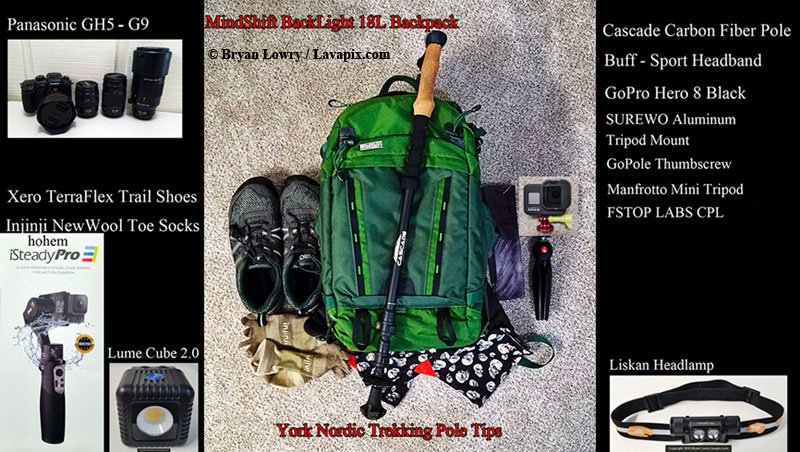
As of 2020, my two most used packs are the Mindshift Daylight 18L and the Shimoda X30 action pack. Each fits a different need. The Mindshift is my daily go-to pack as it's small and nimble. By far my favorite lava tube exploration pack. The Shimoda is for those longer treks where more survival gear is needed. It's a very well-thought-out pack.
My third backpack is the Atlas Athlete Pack.
My first real backpack at the lava flows was the Gregory Banshee. This pack was lean, and I could move fast with it. The clamshell opening worked great. I would also carry my Lowepro Zoom AW Hipster on the waistbelt. The Banshee is long gone, as several years of sharp and hot lava wore it out. It's usually the zippers that give in to the sulfuric acids. The Lowepro is still in use.
My next pack is still one of my all-time favorites. The Mountainsmith Paragon. This pack could have been a bit larger, but it fit me extremely well. I could wear it for 12 straight hours easily. It was a tight fit getting that big Sigma lens in there. I had lots of stuff hanging from that pack on my long outings. That was my best Pu'u O'o vent pack. That pack is no longer with me. I just plain wore it out. 1000 miles of hiking will do that.
There's a huge Cabelas 5500 cu pack in my collection. This is for Mauna Loa and sometimes cold-weather lava hikes. All of my cold-weather gear fits. Also, my Gregory Baltoro 65 has the most comfortable waistbelt and harness system.
(Retired late 2018) The camera backpack I use the most is my F-Stop Tilopa. I've had it since early 2010, and I love it! They've changed a few things with the new model from my older one. The Tilopa is so easy to load my gear into. Which is very important when I have to pack up and move quickly. When I was enquiring about this pack in 2010, they told me it wasn't designed for the kind of weight I said I would be carrying. Many times over 70lbs for long outings of 20 miles and 24 hours. But I have to say it handles it all well. I usually carry 6-8 liters of fluids along with the other gear mentioned above. Lots of other stuff like food, clothing, etc... Even 15 liters on some very long hikes. Yes, that's 15 liters. I have a low-profile chest pack for gear needed without removing my pack. The extra 7 liters on the one hike were hanging from anywhere I could attach them. One hike was for my 50th birthday. 25 miles to the upper lava flow action. 8 miles up hill that took 8 hrs due to the conditions. 7 hours coming back. New hike story, maybe. I don't travel very often anymore, but when I do, the Tilopa fits nicely in the overhead bin. My next F-Stop might be the Satori.
Hiking Boots
This is the other question I'm often asked. "Do you go through a lot of boots?" The answer is yes, of course, it can be for several reasons. The obvious is them melting. I usually know when this is going to happen, and I try my best to prevent it. There have been times when a brand-new $350 pair of boots gets ruined on their first hike. Sometimes I need to cross very wide hot lava flows. It's an art that's learned over many years. Don't try this!!!
Another reason is simply wearing them too long. Its the most common. The lava wears out most boots in about 5-6 hikes. Remember, my hikes are extreme, and as mentioned on another page, I don't use that word loosely.
I have photos here showing some of my melted and horribly worn boots.
Since 2015, I've been wearing Altra Lone Peak,s starting with the 2.5's and currently the 3.0's. These are barefoot shoes with cushioning. My feet have never been so happy and grateful. I won't ever go back to regular shoes. Soon I'll try the newest 4.0's, but I really like the orange and black 3.0's.
As of 2020, the very comfortable Xero TerraFlex shoes are my only hiking shoes, no matter what the terrain is. I like feeling every rock, stone, or whatever. No more rolled ankles. These are featured heavily in my YouTube Lava tube hiking series.
(Now that I have both of my hips replaced in 2018, and my shorter right leg was lengthened to nearly the same length as the left, I no longer need lifts.) After 30+ years, I can now wear any shoe I like.
One thing that makes it difficult for me to wear many boots or even have them right away is my needing a lift on the right one. (No longer needed) I have one leg shorter than the other by more than an inch. For most of my life, I've had a Cobbler do the lifts so they weren't noticed, and they held up. The problem with this is that it took up to 5 weeks to get my new boots, and many times it left me hiking in boots that were falling apart. Check the photos above for a laugh at what I've worn in the past while waiting for my new boots.
These days, I make my own lifts and even alterations to accommodate my two different-sized feet. Oh yeah, one severely flat too. It works well and allows me to set up my new boots right away. I cut off soles from cheaper shoes and use sheet rock screws and Shoe Goo to attach them. This method works very well. I couldn't care less what they look like. They won't be around for very long.
In late June of 2012, I decided to try running and hiking without a lift on my right shoe. The terrain is anything but even. I'm not so sure a lift really helps. I can say that after 32 years of having a heavy right shoe/boot, it's great not having the lift. So far, so good.
I've had everything from HI-Tech, Cabelas, Earth Shoes, Wolverines, Danner, and Merrell. My current pair is Merrell hiking shoes. Not boots. Stopped using Gore-Tex, too. They're great until they fill with water. Heavy-duty hiking boots are well, heavy. Add in thick mud and water, and it's a workout I don't need. So, my current shoes aren't waterproof. No need, as I hike wearing shorts anyway. My Merrell Geomorph Maze Stretch hiking shoes are the best I've ever hiked in. I mean ever. They are so comfortable to me, and they handle every type of terrain I throw at them. Merrell better not stop making them. I have the mesh ones, so rainwater drains out, keeping my feet from getting soaked.
Accessories
A 2021 update is coming soon.
While I do use numerous small gadgets along with my main gear, too many to list, my Goal Zero Nomad 7 portable solar charging panel stands out. Its an easy way for me to recharge camera batteries out in the field. I also use the Guide 10 power pack. The Goal Zero Rock Out Speakers entertain me on my long hikes.
Most times, I'm hiking all night, and I need a powerful and reliable light. The brighter the better is my way of thinking. For years now, I have been using two Life Gear LED 360 Lumen flashlights. They put out a nice white light that shines far out into the night, and they stay bright for several hours. These lights have been through everything you can imagine, and they are still going strong.
*Need some gear tested? My hiking adventures are brutal and will push most any type of gear to its limits.
Contact me if you're a manufacturer and would like something tested.
If it's something I'm interested in, I'll take your product on a few photographic adventures.
Better yet. Let me help you design better gear. If it were possible, I would have my own line of hiking gear designed for the brutality of my adventures. Not sure I could improve on the Merrell Geomorphs.

F-Stop Tilopa and Merrell Shoes Copyright Bryan Lowry/lavapix.com
 Current hikers and trainers



 Loading...